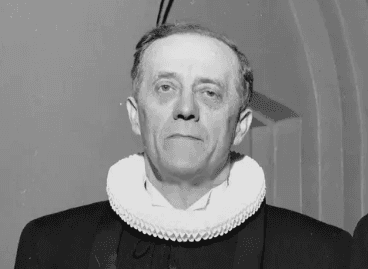
A Clergyman of Many Talents
As a theology student, Arne Skjånes obtained a patent for a matchbox with a “sliding end panel” and separate compartments for unused and spent matches. However, he became a clergyman rather than an inventor, to the benefit of several parishes in the Diocese of Nidaros.
Arne Skjånes (1895–1977): A Clergyman of Many Talents
As a theology student, Arne Skjånes obtained a patent for a matchbox with a “sliding end panel” and separate compartments for unused and spent matches. However, he became a clergyman rather than an inventor, to the benefit of several parishes in the Diocese of Nidaros.
As a theology student, Arne Skjånes obtained a patent for a matchbox with a “sliding end panel” and separate compartments for unused and spent matches. However, he became a clergyman rather than an inventor, serving several parishes with distinction over many years. Skjånes received his degree in theology in 1926 and moved to the Diocese of Nidaros. For twenty years, he served as parish priest in Klæbu and subsequently in Strinda, where he also became rural dean.
In Klæbu, Arne Skjånes fulfilled all the roles traditionally associated with a rural clergyman. He chaired both the parish council and the local education board, and he managed the municipal public library. He had not originally been recommended for the position of parish priest, but following a local campaign that gathered 300 signatures, he was nevertheless appointed by the Ministry. Skjånes managed the rectory farm himself until 1946, when it was taken over by a tenant farmer. This freed up time for his many other duties. Both before and after the war, he spearheaded efforts to build a chapel at Heimdal. He edited the centenary history of Tiller parish in 1950, and from 1946 he served on the board of the new Christian newspaper Dagsavisa. He was also active in the Norwegian Sunday School Association and the Norwegian Church Ministry to Israel.
Arne Skjånes had a keen interest in literature. He reviewed books and wrote poetry. In 1953, he published the poetry collection On Holy Ground. In its opening poem, “The Church of My Home Village”, he looked back on his childhood in Nord-Trøndelag:
Nowhere is more beautiful than By
when morning sunlight gleams in golden splendour,
and the church spire rises against a fiery sky
while starlings sing and twitter in the birches.
A string resounds so softly in my heart
of bygone years that linger clear in memory.
Strinda was both a municipality and an ecclesiastical district surrounding the city of Trondheim. The area was experiencing rapid growth and had churches on both sides of the city. Arne’s brother Ivar had been mayor of Trondheim since 1935, but stepped down in 1951, when Arne began his ministry in Strinda. Living at Berg Rectory, Arne spent his final years writing historical articles, once again demonstrating his wide-ranging interests and talents.
Sources:
· The newspaper Nidaros
· Norsk biografisk leksikon (Norwegian Biographical Dictionary)
The photographs, with the exception of the cover of the poetry collection, were downloaded from DigitaltMuseum.