THE COLOURFUL PRIEST WITH THE ROTTWEILERS
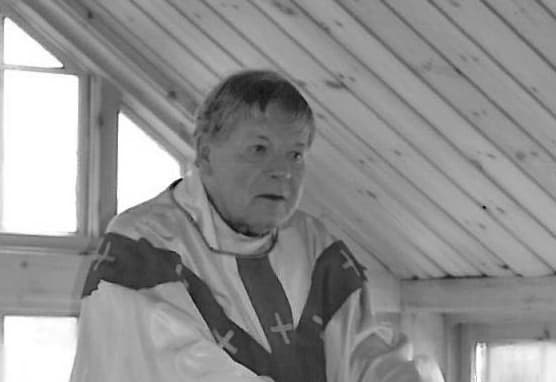
With his warmth and openness, informal manner and keen intellect, the Catholic priest Olav Müller was a much-loved and familiar figure in the city.
OLAV MÜLLER 1924–2018: THE COLOURFUL PRIEST WITH THE ROTTWEILERS
With his warmth and openness, informal manner and keen intellect, the Catholic priest Olav Müller was a much-loved and familiar figure in the city.
Dagfinn Müller, a native of Trondheim, was 16 years old when the Second World War broke out, and he soon became involved in the resistance movement. In 1942, he was forced to flee to Sweden, where he eventually joined the Norwegian police troops. After surviving a serious illness, he began to experience religious stirrings. When the police troops were due to be sent to Finnmark in the late autumn of 1944, he wanted to convert to Catholicism. However, Father Vanneufville of St Eugenia Church in Stockholm refused to receive Müller into the Church without first giving him religious instruction. His friend Odd then explained that Müller would probably be in mortal danger within a week. Special provisions were therefore invoked: the priest asked Müller a series of yes-or-no questions, while Odd sat behind him and indicated with his thumb pointing up or down how he should answer.
Dagfinn Müller later felt called to the priesthood. He eventually joined the Picpus Order, to which the Catholic priests in Trondheim belonged, and took the name Olav after his favourite saint. In 1957, he became a priest at St Olav’s Church in Trondheim, where, apart from a few short periods elsewhere, he served until 1987. During this period, the congregation grew considerably. He subsequently served in several other places before retiring at the age of 85 and returning to Trondheim. When he died in 2018, he donated his body to medical research, in keeping with his motto: “God has given us reason so that we may use it.”
With his rugged appearance and his Rottweilers, Father Olav Müller was a familiar figure in the city. He was a naturally gifted teacher who delivered incisive sermons without a script. He was also a practical and outdoors-loving man and a cheerful, informal and open-minded intellectual. He loved people, particularly children and young people, and was a highly valued pastoral counsellor. His social engagement extended far beyond Trondheim’s Catholic community.
Gudmund Hernes and Ola Moe recall that, after classes at Trondheim Cathedral School, they would often visit Father Olav at St Olav’s Church to discuss and debate with him. In an obituary, the young agnostics remembered Father Olav as a masculine, caring and missionary presence: “… a formidable physical and intellectual force, whether roaming through Bymarka with his dogs or spending long nights engaged in fierce verbal sparring with inquisitive secondary-school students.”