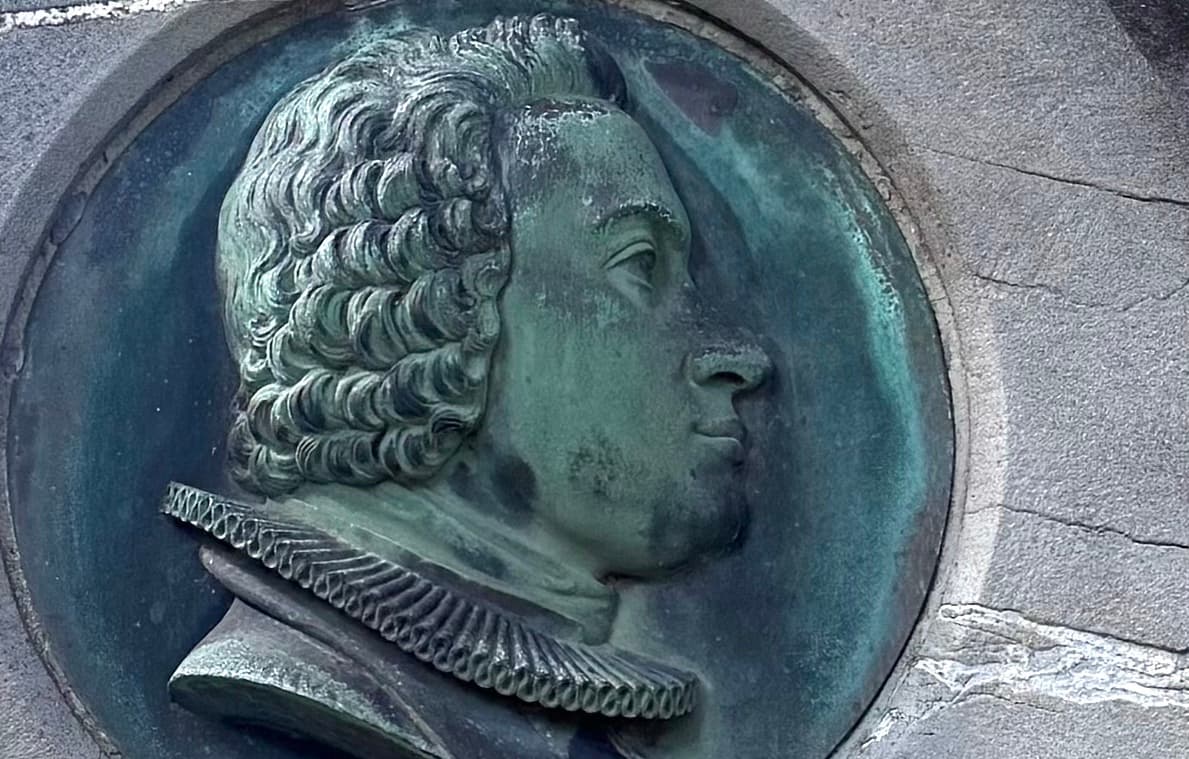
The Bishop Who Would Rather Have Been a Naturalist
Bishop Gunnerus was the last Norwegian scholar to possess scholarly knowledge across a wide range of disciplines, and the first true organizer of a scientific community and research culture in Norway.
Johan Ernst Gunnerus (1718–1773): The Bishop Who Would Rather Have Been a Naturalist
Bishop Gunnerus was the last Norwegian scholar to possess scholarly knowledge across a wide range of disciplines, and the first true organizer of a scientific community and research culture in Norway.
Trondheim’s main street, Munkegata, runs from Ravnkloa to the northern entrance of Nidaros Cathedral. Between the wrought-iron gate and the cathedral door, on the right-hand side of the path, stands the large monument marking the grave of Bishop Johan Ernst Gunnerus. He served as Bishop of Nidaros from 1758 until his death during an episcopal visitation journey to Kristiansund fifteen years later. His family name was originally Gunner, but, like many learned men of his time, he Latinized it to Gunnerus.
Gunnerus was a theologian who earned his doctorate in Germany. His true passion, however, was natural science, particularly zoology and botany. He used his position as bishop to encourage the clergy to engage in scientific studies, and he conducted investigations of the natural world during his own visitation journeys. His principal scientific work is known as Flora Norvegica.
Gunnerus maintained a correspondence with the Swedish botanist Carl Linnaeus, who named a genus of plants in his honour. Linnaeus wrote of Gunnerus:
“There is not, nor has there ever been, a bishop like you in this world. You alone acknowledge both of God’s books: Revelation and Nature. You also instruct your subordinate theologians to read the Book of Nature (…) Would that we had you as Archbishop of Uppsala!” (translated from Latin)
In 1760, Gunnerus, together with Gerhard Schøning and Peter Andreas Suhm, founded what became the Royal Norwegian Society of Sciences and Letters (Det Kongelige Norske Videnskabers Selskab). The Society’s library, Norway’s oldest scientific library, bears his name today as the Gunnerus Library and forms part of the NTNU University Library.
Gunnerus was one of the last scholars to possess extensive knowledge across many different fields of learning, and the first true organizer of a scientific community and intellectual environment in Norway.
For one hundred years, his coffin stood in the great burial vault beneath the nave of Nidaros Cathedral. In 1872 it was removed, together with approximately one hundred other coffins, and reburied on the north side of the cathedral.