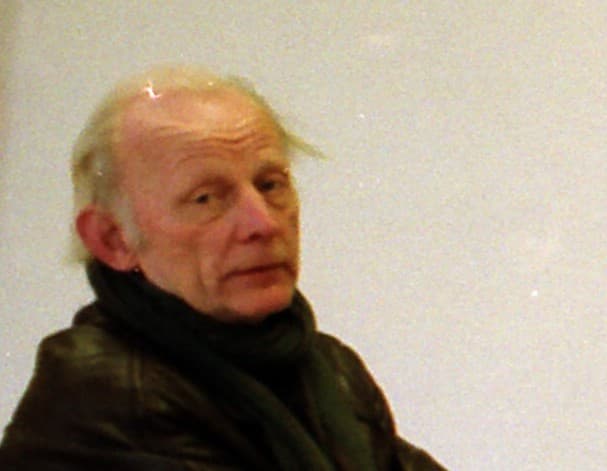
The socially engaged painter
Håkon Bleken’s final resting place is near Nidaros Cathedral, in the protected cemetery where very few people are buried today.
Håkon Bleken 1929–2025
The socially engaged painter
Håkon Bleken’s final resting place is near Nidaros Cathedral, in the protected cemetery where very few people are buried today. Burials in existing family plots are still permitted, however, and Bleken’s urn has been interred in the plot where his mother, father and maternal grandparents are also buried.
Bleken was one of Norway’s greatest visual artists of his generation and, by a considerable margin, the one with the longest career. Until the very end, he continued to produce large numbers of paintings, many of them on a monumental scale, and always of the same high quality. Exhibitions followed one after another, with new ones constantly in preparation. Bleken’s art never lacked interest from galleries, museums or the public. Even so, in his later years he was overwhelmed by the fact that the attention and demand reached still greater heights.
Håkon Bleken received the principal part of his artistic education at the Norwegian National Academy of Fine Arts in Oslo, as did a number of other young talents from Trøndelag. Unlike many of them, however, Bleken returned to Trondheim and made his home city his base for the rest of his life. From his home and studio in Dyrborgveien, he could look down at an angle towards his childhood home in Valkendorfs gate on Øya. His love for Trondheim was profound, and one clear expression of this close and affectionate relationship was that he became one of the city’s most outspoken critics. More than most, he sharpened his pen and made his voice heard whenever he believed that something threatened the city’s well-being.
Although many fellow artists left Trondheim, enough remained for the city to retain a vibrant artistic community. From the 1950s onwards, Bleken played a central role in this community, not least through his position at the Department of Form and Colour at the Norwegian Institute of Technology, where his colleagues included Lars Tiller, Roar Wold and Halvdan Ljøsne. Together with Ramon Isern, they formed Group 5, which made a major contribution to the breakthrough of modern painting in Norway. At the same time, they were all individualists who followed their own paths. Håkon Bleken travelled furthest and ultimately stood alone, the last of his generation.